Overview Summary
- Corrosive air rapidly shortens the life of standard industrial ventilation equipment.
- Fiberglass-reinforced plastic (FRP) fans provide inherent corrosion resistance without relying on coatings (although special coatings & features can be added for extra protection).
- FRP construction significantly extends equipment life and reduces downtime in harsh environments.
- Consistent airflow performance helps protect scrubber efficiency, air quality, and compliance.
- FRP fans reduce long-term operating costs by minimizing emergency repairs and premature replacements.
- These advantages make fiberglass fans a smart choice for wastewater, chemical, and semiconductor facilities.
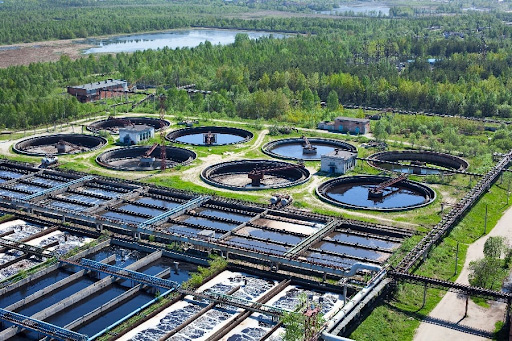 Corrosive airstreams create some of the most challenging conditions for industrial ventilation systems. In wastewater treatment plants, semiconductor fabrication, and chemical processing operations, airborne compounds such as hydrogen sulfide (H₂S), solvents, acids, and moisture accelerate the deterioration of traditional steel or aluminum fans. Even when metal fans are coated, daily exposure to corrosive compounds often leads to coating failure, rust, vibration issues, and shortened equipment life.
Fiberglass-reinforced plastic (FRP) fans have become a go-to solution for facilities that cannot afford that kind of performance drift or downtime. Because they are engineered specifically for corrosive conditions, fiberglass fans provide mechanical durability and predictable airflow where metal fans struggle.
Below are three key ways FRP fans improve performance, reliability, and total cost of ownership in corrosive airflow applications.
1. Fiberglass Resists Chemical Attack Where Metal Fails
In environments where H₂S, acids, caustics, or chemical byproducts are present, corrosion is an unavoidable reality for metal fan construction. Even minor scratches in protective coatings can expose metal to corrosive agents, leading to pitting, flaking, and eventual structural deterioration.
Fiberglass fans take a different approach: the corrosion resistance is built into the material itself, not applied as a surface layer. This makes FRP especially effective in areas such as:
- Odor control and scrubber exhaust systems
- Sludge handling and solids processing areas
- Semiconductor wet process exhaust
Why this matters:
Less corrosion means fewer unexpected failures, reduced safety risks, and longer service intervals, critical benefits for maintenance teams who need predictable uptime and reliable airflow performance.
2. Longer Equipment Life Reduces Replacement and Downtime Costs
Corrosion doesn’t only threaten fan housings. Over time, chemical exposure can compromise impellers, hardware, shaft connections, and balancing. As deterioration progresses, vibration increases and efficiency declines, raising the likelihood of unplanned shutdowns.
FRP fans maintain structural integrity far longer in harsh environments, supporting:
- Fewer emergency replacements
- More predictable preventive maintenance cycles
- Lower lifetime replacement frequency
For wastewater treatment plants, chemical facilities, and semiconductor operations—where both uptime and budget stability are non-negotiable—this extended equipment life directly supports long-term operational goals.
3. Fiberglass Fans Support Consistent Airflow in Critical Systems
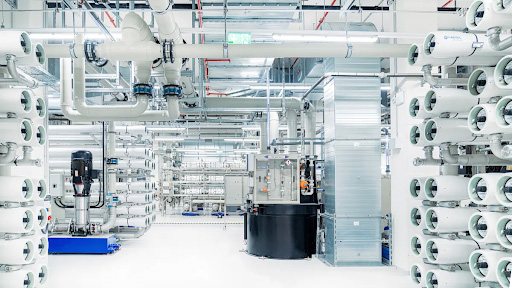 Scrubber systems, odor control systems, and chemical process exhausts depend on stable airflow to maintain air quality and meet regulatory requirements. When corrosion affects a fan’s performance, it can reduce static pressure, compromise scrubber efficiency, and lead to compliance challenges.
Fiberglass fans help maintain:
- Stable airflow and static pressure
- Predictable scrubber and exhaust system performance
- Long-term compliance with air quality and safety standards
Because FRP fans resist the performance degradation that often impacts coated metal units, they are widely used in systems where airflow directly influences environmental control and process consistency.
Where J.E. Phillips Co., Inc. Supports Corrosive Airflow Challenges
Facilities that operate in corrosive environments often need more than a standard fan. They need guidance on selecting the correct materials, performance characteristics, construction, and accessories for their specific application.
J.E. Phillips Co., Inc. offers fiberglass-framed centrifugal fans, industrial ventilation systems, and engineered airflow solutions designed to perform in corrosive or chemically aggressive environments. Our team helps evaluate application requirements, airflow demands, chemical exposure, and long-term maintenance considerations to ensure systems stay reliable and compliant.
Ready to Improve Your Corrosive Airflow System?
If your facility is facing corrosion-related failures, excessive maintenance, or declining airflow performance, our team can help evaluate the best fan configuration and material selection for your application
Contact us to discuss your next project.