
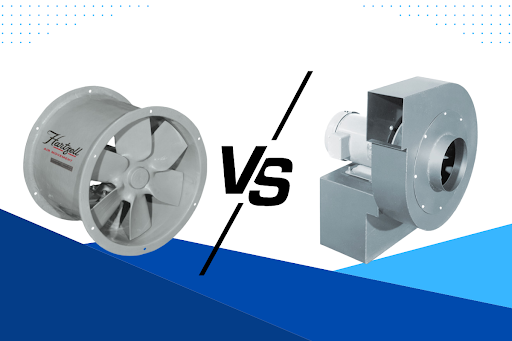
 When selecting a fan for an OEM system, whether it is for a conveyor line, an oven, or an exhaust process, you need to determine what type of fan you need for your application. Two widely used types of industrial fans are centrifugal fans and axial fans. Below we look at how these types of fans compare.
While both types of fans move air, the mechanisms by which they do so, and the operational environments they are designed for, are fundamentally distinct. Choosing the appropriate fan type is crucial for reliable performance and preventing expensive operational interruptions.
Centrifugal Fans: Built for Pressure, Precision, and Durability
Centrifugal fans are the workhorses of industrial air movement. Air enters axially through the inlet, hits the impeller blades, and exits at a 90° angle, handling higher static pressure than axial fans. Centrifugal fans are best suited for:
- Ducted systems that require long runs or multiple bends
- Dusty, high-temperature, or corrosive environments (such as wastewater, food processing, dust collection, or process ventilation)
- Filtration and scrubber systems, where steady airflow under resistance is critical
Centrifugal Fan Advantages:
- High pressure capability with lower noise
- Performs well against filters, dampers, or duct restrictions
- More efficient in particulate-laden airflows
- Long service life when built with proper corrosion-resistant materials and maintained properly
Common Centrifugal Fan Applications:
FRP centrifugal fans paired with scrubbers for wastewater odor control, centrifugal or cast blowers integrated into heavy-duty OEM systems.
Axial Fans: Built for Volume and Simplicity
Axial fans move air parallel to the shaft, like a propeller. They excel in high-volume, low-pressure applications where air moves freely without significant resistance. Axial fans are best suited for:
- Cooling or ventilation in open systems (equipment enclosures, electronics, or process areas)
- OEM systems like drying lines, conveyors, paint booths, or cooling tunnels
- Applications where space is tight and duct runs are short
Axial Fan Advantages:
- Delivers high airflow volume with minimal energy use
- Compact, lightweight, and easy to install
- Simplified maintenance and access
- Ideal for general ventilation or cooling where pressure loss is minimal
Common Axial Fan Applications:
Axial fans used in oven cooling systems or building ventilation where airflow moves freely without backpressure.
The Key Differences at a Glance
| Feature | Centrifugal Fan | Axial Fan |
|---|---|---|
| Airflow Direction | 90° turn (radial) | Straight through (axial) |
| Pressure Capability | High | Low |
| Air Volume | Low-High | Low-High |
| Efficiency | Best for high-pressure systems | Best for open systems |
| Maintenance | Low (clean environments) | Easy access |
| Applications | Scrubbers, process ventilation, exhaust | Cooling, general ventilation |
| Typical Materials | FRP, steel, aluminum, specialty materials | FRP, steel, aluminum, specialty materials |
Selecting the Right Fan for Your OEM Design
If your system relies on pressure stability or must withstand corrosive or contaminated airflows, centrifugal fans are typically the better choice.
If your priority is airflow volume with minimal restriction and footprint, axial fans provide greater efficiency and a lower upfront cost.
Pro Tip for Engineers:
Before specifying, confirm that your fan meets Fan Efficiency Index (FEI) requirements under California Title 20. Both centrifugal and axial fans can comply — but only when correctly paired with the right motor and operating point.
J.E. Phillips Co, Inc: Helping You Match Design to Performance
Choosing the right fan isn’t just about airflow or horsepower, it’s about understanding your process and environment.
J.E. Phillips Co, Inc. helps OEM engineers and maintenance teams:
- Compare performance curves and static pressure requirements
- Review materials for corrosion resistance
- Evaluate drop-in replacement options
- Ensure compliance with FEI, OSHA, and environmental standards
Whether you’re upgrading a current system or developing a new OEM design, the J.E. Phillips Co, Inc. team offers responsive, technically informed support to help you get it right the first time.
Need help choosing between centrifugal and axial fans?
Contact J.E. Phillips Co, Inc. today to review your system requirements with a local representative who understands your air movement challenges.