Key Takeaways
- Batch ovens and continuous ovens require fundamentally different airflow strategies to achieve consistent heating.
- Proper industrial fan selection directly impacts product quality, cycle times, energy efficiency, and production throughput.
- Batch ovens require uniform circulation around changing load configurations, while continuous ovens must maintain consistent airflow across moving products.
- Factors such as airflow volume, static pressure, operating temperature, and air distribution patterns all influence oven performance.
- High-efficiency plug fans have become a popular solution for many OEM process ovens because they deliver uniform airflow while reducing maintenance and energy costs.
- Selecting the right air movement solution early in the design process helps manufacturers avoid uneven curing, excessive operating costs, and production bottlenecks.
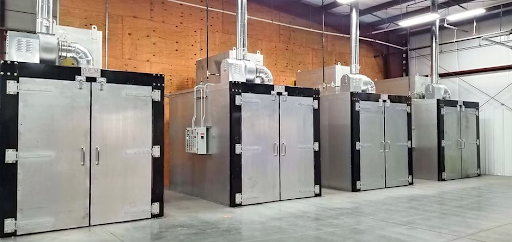
Whether you’re designing new equipment, upgrading an existing production line, or replacing aging components, understanding how airflow requirements differ between batch ovens and continuous ovens can improve product consistency, reduce operating costs, and increase throughput.
Although both oven types perform similar functions, they present very different ventilation challenges. Choosing the right industrial fan is one of the most important decisions in achieving reliable thermal performance.
Batch Ovens vs. Continuous Ovens: Understanding the Difference
Both oven designs rely on heated air, but they operate in very different ways.
Batch Ovens
Batch ovens process one load of products at a time. After materials are loaded and the door is closed, heated air circulates until the entire batch reaches the required process conditions.
Typical applications include:
- Powder coating
- Paint curing
- Composite curing
- Heat treating
- Adhesive curing
- Laboratory testing
- Specialty manufacturing
Since every batch may contain different part sizes, shapes, or loading patterns, airflow conditions often change from cycle to cycle.
Continuous Ovens
Continuous ovens move products through the heated chamber using conveyors or other transport systems.
Common applications include:
- Automotive manufacturing
- Electronics production
- Food processing
- Packaging operations
- High-volume industrial manufacturing
Unlike batch systems, continuous ovens must deliver consistent airflow to products that are constantly entering and exiting the heating chamber while minimizing heat loss through openings.
Batch Ovens vs. Continuous Ovens at a Glance
| Feature | Batch Ovens | Continuous Ovens |
|---|---|---|
| Production Style | One load at a time | Constant product flow |
| Primary Airflow Challenge | Uniform circulation around changing loads | Consistent airflow across moving products |
| Typical Priority | Temperature uniformity | Throughput and process consistency |
| Common Airflow Obstacles | Dense loads, shelving, dead zones | Conveyor openings, product spacing, heat loss |
| Fan Selection Focus | Air distribution and circulation | Air volume, pressure stability, energy efficiency |
Why Airflow Is Just as Important as Temperature
Two industrial ovens can operate at exactly the same temperature while producing dramatically different results. The difference is airflow.
Temperature measures how hot the oven becomes. Airflow determines how effectively that heat reaches every surface of the product.
When airflow is inconsistent, manufacturers often experience:
- Hot and cold spots
- Uneven curing or drying
- Longer process cycles
- Increased scrap and rework
- Higher energy consumption
- Reduced production throughput
Properly engineered air circulation helps ensure every product receives the same thermal exposure throughout the heating cycle.
Airflow Challenges in Batch Ovens
Batch ovens are rarely loaded the same way twice. One production run may contain densely packed components, while the next may include a single oversized assembly or multiple shelving configurations. These variations significantly affect how heated air travels through the chamber.
Common airflow challenges include:
- Dead air zones behind large components
- Uneven heating across racks or shelves
- Temperature differences from top to bottom
- Longer recovery times after loading
- Air bypassing densely packed parts
Instead of simply moving large volumes of air, the ventilation system must distribute airflow evenly around the entire load. Proper fan selection helps eliminate stagnant areas and maintain consistent circulation throughout the process.
Airflow Challenges in Continuous Ovens
Continuous ovens introduce a different set of engineering considerations. Because products remain in motion, airflow must stay consistent across every stage of the process, regardless of production speed or throughput.
Engineers typically evaluate factors such as:
- Conveyor speed
- Product spacing
- Heat loss at entry and exit openings
- Production volume changes
- Residence time within the heating chamber
Even minor airflow inconsistencies can create temperature variations that affect product quality across thousands of parts. For manufacturers operating high-volume production lines, maintaining consistent airflow is essential for maximizing throughput while minimizing waste.
How Engineers Determine Industrial Oven Airflow Requirements
Selecting the right fan involves far more than choosing a unit capable of operating at elevated temperatures. Engineers evaluate several performance characteristics to ensure the airflow system matches the specific thermal process.
Important considerations include:
- Required airflow (CFM)
- Static pressure requirements
- Operating temperature
- Air distribution pattern
- Oven dimensions
- Available installation space
- Energy efficiency goals
- Maintenance accessibility
Matching these factors to the application helps optimize both process performance and long-term operating costs.
Why Plug Fans Are Becoming a Preferred Choice for Industrial Ovens
Many OEM equipment manufacturers are choosing plug fans for industrial ovens because they combine efficient airflow with compact equipment design.
Unlike traditional housed centrifugal fans, plug fans can often be integrated directly into process equipment while providing excellent airflow distribution throughout the heating chamber.
Key advantages include:
- Uniform air circulation
- High operating efficiency
- Compact installation footprint
- Fewer mechanical components
- Reduced maintenance requirements
- Lower energy consumption
- Greater design flexibility for OEM equipment
For both batch and continuous oven applications, plug fans help create more consistent airflow, supporting better product quality while improving overall system efficiency.
Preventive Maintenance Helps Preserve Airflow Performance
Even a well-designed oven can lose efficiency if airflow gradually declines. Routine inspections should include:
- Fan blade condition and cleanliness
- Bearing wear
- Motor amperage
- Air filters
- Ductwork restrictions
- Airflow balance throughout the oven
Monitoring airflow as part of a preventive maintenance program helps identify developing issues before they begin affecting product quality or production schedules.
Choosing the Right Air Movement Solution
Every thermal process has unique airflow requirements. A powder coating oven requires different circulation characteristics than a conveyorized drying line. Likewise, a composite curing oven has different ventilation demands than a food processing application.
Selecting an industrial fan based solely on temperature ratings can lead to uneven airflow, excessive energy consumption, and unnecessary maintenance costs.
JEPCO works with OEMs, maintenance managers, and process engineers to help identify air movement solutions that match each application’s airflow, pressure, temperature, and performance requirements. Whether you’re designing new equipment or upgrading an existing process oven, we can help you select industrial fans that improve consistency, efficiency, and long-term reliability.
If you’re evaluating industrial fans for a new oven design or looking to improve the performance of an existing system, contact JEPCO. Our team can help you select an air movement solution that supports reliable, efficient thermal processing for your specific application.